Most science teaching has a shape. A fact arrives, an explanation follows, a question is asked, and the question has an answer that the teacher already holds. The child's job is to arrive at it. By about nine, a reasonably bright child has worked out that the real skill being taught is guessing what the adult wants.
We build lessons differently, and this is an attempt to explain how, because it is the part of DeepKids Gurukul that is hardest to see from a feature list and is the reason the app exists at all.
In this article
Three kinds of statement, kept apart
Children are usually given science, opinion and tradition in the same tone of voice, and are left to sort out later — sometimes much later — which was which. We think that is the single most damaging thing done in a science lesson, and most of our writing rules exist to prevent it.
Every lesson keeps three kinds of statement separate, and the child always knows which one they are hearing.
- What science has found — stated plainly, with how we know it. "Almost every atom in your body, apart from hydrogen, was made inside a star."
- Our own stance — stated plainly too, and immediately followed by the view that disagrees. "A root chooses where to grow. Some scientists call this an automatic response."
- What people have taught — named and sourced. "The Chandogya Upanishad says…", never "it is written that…"
And a fourth category that school science is strangely reluctant to use: nobody knows. Where the science is an idea rather than a finding, we say so. Where it is genuinely open, we say that too. A child who learns that "open question" is a normal thing for a grown-up to say has been given something more useful than any particular fact.
What the science whispers
Every unit ends with one idea that its science points to but cannot prove on its own. We call these deep truths, and the test for them is strict: it has to be an interpretation of that unit's science, not a slogan that could be pasted onto any lesson.
Four real ones, from four different units:
- How water climbs a plant. "A tree does not lift its own water. The sun pulls it up from the leaves, one water particle tugging the next. What looks like the plant's work is the sky working through it."
- Stretching springs. "A spring sitting still is not doing nothing. Its tiny particles hold on to each other all the time, and that holding is its shape. Pull gently, and they pull back together. Pull too hard, and they let go and hold on to new neighbours."
- Measuring forces. "Nature has pushes and pulls, but it has no numbers. Numbers are a language people made together, so that everyone means the same thing. A newton is a word in that shared language."
- Testing materials. "However strong a material is, one small crack can grow and break it. A thing is only as strong as its weakest crack. So engineers hunt for tiny cracks before they grow."
None of these is poetic for the sake of it. Each is literal, each could only have come from the lesson it belongs to, and each is written in words an eight-year-old already has. A child should understand a deep truth, not merely enjoy how it sounds.
Breaking a habit of thinking
Most of these ideas work by catching a habit — a label we have quietly confused with the thing itself.
Take thinking. We say "brain", or "neurons", the way people say Xerox for any photocopier. But underneath, thinking is sensing, ions moving, signals passed, genes switching on and off — and every cell does that, including a bacterium. So thinking turns out to be older and wider than brains. That is not mysticism; it is what happens when you look at the mechanism instead of the word.
Or take forces. A child is taught lift, friction, air resistance, a push, a spring — five different things with five different names. At the level of atoms they are one thing: electrons repelling electrons. And physics keeps doing this. Maxwell joined electricity and magnetism in 1865. Electromagnetism and the weak force were joined in the 1970s. Whether gravity joins them is still open.
Other habits worth breaking, and each gets its lesson: living versus non-living, solid versus empty, me versus the world, useful versus useless.
The question we leave open
Every unit also asks one question its science raises but cannot settle. The model for all of them is this.
A bee looking at a red fruit does not see red. Bees see ultraviolet and cannot see red at all, so to a bee that fruit is something a human has no word for. A child looking at the same fruit sees red.
So — are the two of you seeing the same thing differently, or are you seeing different things?
There is no answer at the bottom of the page. The child argues it out, and the parent is explicitly told not to settle it. The same question reappears in a different coat all through the curriculum: is a sound in the air or in the ear? Is a magnetic field a thing, or a way of describing? Where does a meal end and you begin?
A child who questions their way to an idea owns it. A child who is handed it only borrows it.
Where we take a position most people don’t
We should be straight about this, because it is the part some families will love and others will not want.
DeepKids takes the view that minds are not a human speciality, or even an animal one. Our lessons say that plants sense, remember, decide and communicate — that a root chooses where to grow, that a touch-me-not learns a harmless touch is harmless, that plants warn each other. We write it in the ordinary voice of a science lesson rather than hedging it into a maybe.
Plenty of scientists would describe the same findings as automatic responses, with no deciding involved. That view is given in every lesson where ours appears, in its own words, fairly, straight after ours. The child gets both and is left to think.
Our reasoning is the same first-principles move as before: nobody has shown that a plant does not remember or choose, and the confident denial is as much an assumption as the claim. So we never write that a plant, a microbe or a particle "can't really" think. If a lesson needs a mechanism, it describes the mechanism and stops there.
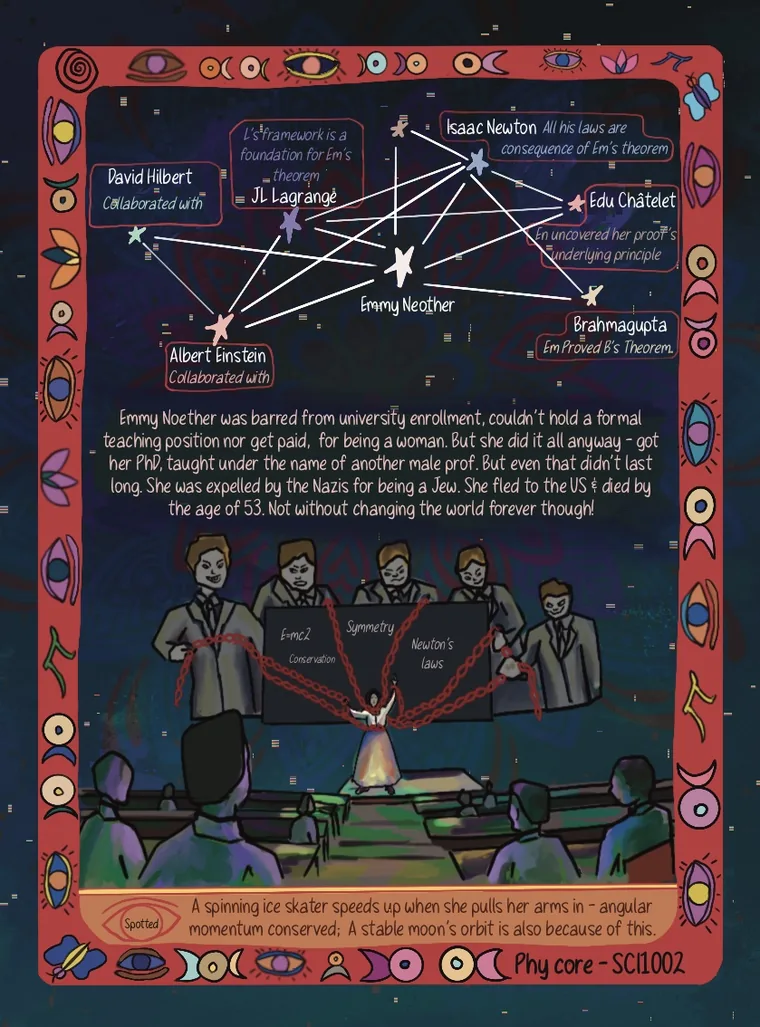
The same instinct shows up elsewhere. Women and girls do the science in our lessons, lead, discover, and are credited by name — and where credit was taken from someone, we say so. Humans are animals, always "humans and other animals", never "humans and animals". A forest or a bee matters for itself, not for what it gives us.
And the traditions we draw on are given as voices, never as proof. Where they disagree with each other, we say so. India's own thinkers argue about all of this: the Charvaka school held there is only matter; the Buddha taught anatta, no fixed self; Madhva taught that soul and God are forever two. Most neuroscientists today think awareness comes from brains. A position that cannot sit calmly beside all of those is not worth teaching to a child.
We offer teachings, never membership. No prayers, no rituals, no "our god". The same lesson should be welcome in any family's home.
Where we refuse to bend
Having a point of view makes it tempting to recruit the science, and this is where a lot of otherwise lovely children's material goes wrong.
So, plainly: quantum physics does not prove anything about consciousness. In physics, "observer" means anything that measures — a detector, a photographic plate — not a mind. Wherever quantum ideas appear in our lessons, that sentence appears with them. The parallels between physics and older ways of describing the world are real and worth showing a child. They are parallels. They are not evidence.
In the same spirit, everything is labelled for what it is. That the atoms in you were made inside stars: settled. That all living things share one ancestor: settled. That the universe might have exactly zero total energy: an idea, published in 1973, still argued about. What consciousness actually is: open. Nobody knows.
A child can hold all four of those at once. Most adults were never shown how.
Whether this is for your family
This approach asks more of a parent than a worksheet does. The lessons tell you what to have ready, what to do and what to ask — no teaching background is needed — but they will regularly ask you to sit with a question you cannot answer, in front of a child who wants you to answer it. Some parents find that the best part. Others find it exhausting, and that is a reasonable thing to find.
It is also, we think, the honest way to teach science. Science is not a pile of settled answers; it is a long argument that keeps turning out to be more interesting than the last version of itself. A child taught that way is harder to fool later — by a textbook, by an advertisement, or by us.
DeepKids Gurukul is a homeschooling app for Indian families with children aged 6 to 10. It plans each day, guides the parent through every lesson, and tracks what has been covered. You can follow NCERT, Cambridge Primary or NIOS chapter by chapter, or the DeepKids track, which is where this way of teaching lives — topic-led, with full lessons, experiments, games and worksheets, mapped to what every board teaches in that class. Every feature works without AI, and you can try it without signing in.
If you are earlier in the decision than this, start with our honest guide to homeschooling in India, or the practical question of how to shape a homeschool day.
See how a lesson is actually built
The DeepKids track is topic-led rather than textbook-led, with full lessons, experiments, games and worksheets — mapped to what every board teaches in that class. For Indian families with children aged 6 to 10.
Open DeepKids Gurukul →